Where the two systems came from
Both systems are based on Jung’s ideas about psychological types, including differences between extraversion and introversion and how people perceive and evaluate what’s happening around them. But the systems developed separately after that—they’re not just two names for the same test.
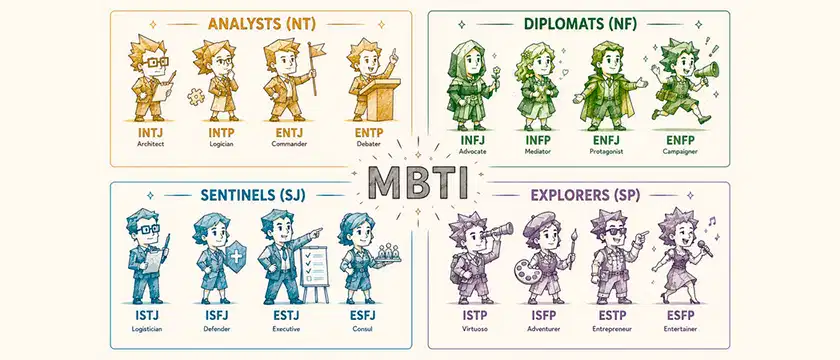
MBTI, or the Myers-Briggs Type Indicator, was developed by Katharine Briggs and Isabel Myers. In popular descriptions, a result is based on four preferences: E or I, S or N, T or F, and J or P. These combine to form a four-letter code, such as ENFP or INTJ. MBTI is used as a way to talk about preferences in work, communication, and decision-making.
Socionics was developed by Aushra Augustinavičiūtė. It also identifies 16 types, but looks at how people process information and interact with one another. Each type has several labels: a four-letter code, an abbreviation such as ILI, and a familiar nickname, such as “Balzac.” These nicknames are labels for types, not claims about the personalities of historical figures.
Imagine two colleagues preparing a presentation. One first clarifies the goal and makes a plan; the other suggests ideas and adjusts the structure as they go. Both systems can help you ask questions about these habits, but each explains them within a different model. Behavior alone isn’t enough to reliably identify someone’s type: tasks, experience, and circumstances all play a part.
It’s also worth keeping the limitations in mind. MBTI and Socionics are popular tools for self-discovery, but neither provides a complete scientific account of personality. Be especially cautious about Socionics-based predictions of compatibility. A test is no substitute for professional advice.
What the letters mean—and why they’re easy to mix up
In MBTI, the four pairs describe preferences. They’re not measures of ability or rigid boundaries: an introvert can enjoy parties, and someone who prefers planning can still change their plans.
- E and I — extraversion and introversion. In the system, this distinction relates to where attention is directed and how someone prefers to engage with the outside world. It’s not the same as being outgoing or shy.
- S and N — sensing and intuition. Sensing is more often associated with attention to concrete details and experience, while intuition focuses more on connections, possibilities, and broader patterns. Everyone can use both approaches.
- T and F — thinking and feeling. When evaluating a situation, someone may emphasize logical criteria or focus on values and how a decision affects people. F doesn’t mean being emotional, and T doesn’t mean lacking empathy.
- J and P — judging and perceiving. In simplified descriptions, J is associated with a preference for certainty and closure, while P is linked to staying open to options. This isn’t a division between organized and disorganized people.
Socionics also uses the terms extraversion and introversion, sensing and intuition, logic and ethics, and rationality and irrationality. The labels are similar, but their definitions and roles in the model don’t fully match those in MBTI. For example, Socionics “ethics” isn’t a measure of morality, and “irrationality” doesn’t mean an inability to reason.
Pay particular attention to the last letter. In common Socionics notation, lowercase j and p indicate whether a type is rational or irrational. Capital J and P in MBTI follow a different logic, especially for introverts. Different websites may also use different notation. To see your own code in the context of the four scales, you can take the online MBTI test, then compare its description with your Socionics result.
Socionics and MBTI type matches: Can you convert one type to the other?
Type-matching charts can be useful for getting started, but there’s no single reliable way to convert between the systems. They typically match types based on similar descriptions or an assumed order of functions. But chart creators may interpret functions differently and use different notation. The result also depends on how accurately the original type was identified.
One common approach accounts for the difference in how the final letter is written: for extraverted types, the letter often stays the same, while for introverted types, J and P switch places in Socionics notation. For example, this approach may match MBTI ENTP with Socionics ENTp, and MBTI INTP with INTj. This is a guide to reading a chart, not a rule that automatically determines your Socionics type.
INTJ in Socionics: Why Balzac often comes up
Search for “INTJ in Socionics” and you’ll often find ILI, or the Intuitive Logical Introvert, known as “Balzac.” It’s often written as INTp. This match is based on a presumed similarity between the leading functions: introverted intuition and extraverted logic. But functions with the same names aren’t necessarily defined in exactly the same way in both systems.
The catch is that Socionics INTj usually refers to a different type: LII, or the Logical Intuitive Introvert, known as “Robespierre.” If you simply copy the four letters of the MBTI type INTJ without taking capitalization and notation into account, you may end up with a different match than the chart intended.
Imagine your MBTI result is INTJ, and you recognize in the ILI description a habit of anticipating how events might unfold. That’s a reason to explore the type further, but it isn’t proof: people with other results can have the same habit. Compare the full descriptions, pay attention to how the functions are defined, and check how the site writes its type codes. If a Socionics test suggests LII or another type, there’s no need to assume one result must be wrong: the tools ask different questions and use different models.
How to use your results without labels
Start with a specific question about yourself rather than looking for the perfect code. For example: “What helps me make a decision when I don’t have much information?” or “How do I prefer to talk through disagreements?” That way, a type description becomes something to reflect on, not a ready-made answer.
- Answer based on your usual behavior. Think about different situations, not just your latest workweek or the person you’d like to be. If a question depends on the circumstances, choose the option that fits most often.
- Read beyond the final code. Look at the preferences the result describes and note which parts don’t fit you. Mismatches can be useful, too: they may show where the model falls short or where your answers reflect something specific to you.
- Put the conclusions to the test. Say a description suggests you like structure. Try planning a meeting in advance, then compare the experience with a more flexible format. What works for you in practice matters more than the label.
- Don’t type other people from a distance. Someone’s silence in a meeting could be due to fatigue, an unfamiliar topic, or the format of the discussion—not introversion. It’s better to ask them directly about their preferences.
Socionics descriptions of relationships between types can suggest topics to discuss, but they can’t predict whether a friendship or working relationship will succeed. Clear agreements, respect for boundaries, and a willingness to talk through difficulties matter, too. Choosing a partner or rejecting a job candidate based solely on their type would be a pretty bold conclusion to draw from a test.
If you’d like to revisit the shared foundations of both systems, try the Jungian theory test. For a lighthearted look at everyday habits, try this fun MBTI quiz about the chaos crew—just treat the result as entertainment.
Frequently asked questions
Are Socionics and MBTI the same thing?
No. The systems share Jungian roots and each has 16 types, but they define traits, functions, and notation differently. Results may be similar without being interchangeable.
Which Socionics type matches INTJ?
In common MBTI charts, INTJ is often matched with ILI, or “Balzac,” which may be written as INTp in Socionics. It’s an approximate match, not a guaranteed result from a separate Socionics test.
Why did my tests give me different results?
They may use different models, wording, and scoring methods. Your answers can also be affected by context: for example, you may have thought about work for one test and relaxation for another. Compare the descriptions and pay attention to the specific questions.
Can you determine compatibility from personality types?
A typology can suggest hypotheses about communication differences, but it can’t reliably predict how a relationship will go. Discussing expectations and paying attention to how you interact in real life is more useful than relying on a chart alone.
Which test to take next
MBTI and Socionics offer different maps of personality, not a precise translation from one language to another. To explore the Socionics approach for yourself, take the “What’s Your Socionics Type?” test at the beginning of the article and compare the result with its description—without treating it as a definitive label.
Here are a few more tests to compare results and have some fun: