What are intertype relationships?
Socionics divides people into 16 sociotypes and suggests that each type has its own ways of processing information and making decisions. In this model, intertype relationships are the dynamics thought to arise when two types interact. The term isn’t limited to romance: the same labels are used for friendships, family relationships, and work.
Imagine two people on a trip together. One plans the route in advance and checks the tickets; the other is happy to change plans and find interesting places along the way. A socionics-based interpretation might describe this as a combination of different strengths. But there could be many other explanations: travel experience, habits, tiredness, or how responsibilities are divided.
It’s important to distinguish between a description within a model and an established fact. Sociotypes and predictions about relationships haven’t been reliably confirmed by science. A test result can depend in part on how you’re feeling when you answer, and shouldn’t be treated as a diagnosis or used as the basis for important decisions.
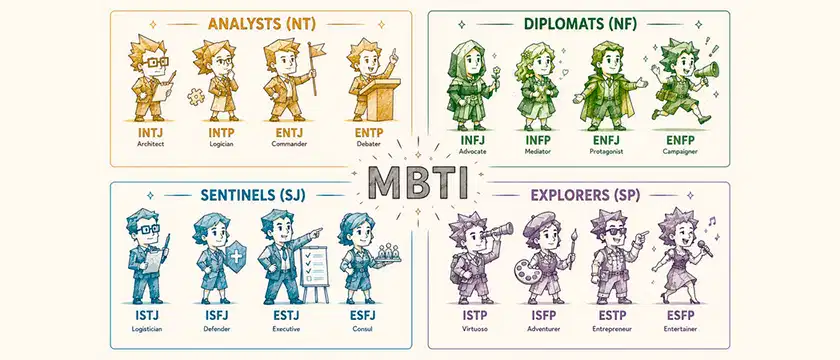
Socionics is sometimes compared with MBTI: both systems use the language of personality types, but their types and labels shouldn’t automatically be treated as equivalent. If you’d like to explore another model, try the 16 Personality Types MBTI Test.
Types of intertype relationships
Socionics describes different combinations of types. Here are some common labels and what they usually mean. This isn’t a scale from “good” people to “bad” people: even enjoyable relationships require both sides to pay attention to each other’s needs.
- Dual. Partners are thought to complement each other: one person’s strengths may help where the other needs support. For example, one might suggest options while the other helps choose a practical next step.
- Identical. People of the same type may find it easy to recognize their own way of thinking in each other. At the same time, shared habits don’t always help them notice what they’re both missing.
- Mirror. Partners may be interested in similar subjects but approach them differently. One wants to discuss an idea; the other wants to put it to the test right away.
- Activation. This combination is described as energizing and action-oriented. But a constant high-energy pace can become tiring without breaks.
- Semi-dual. In the model, these relationships involve some degree of mutual complementarity: support may be felt in certain situations, while misunderstandings arise in others.
- Mirage. These relationships are often described as easygoing and relaxed. But pleasant conversation may not be enough when it comes to agreeing on deadlines, money, or responsibilities.
- Business. The focus is on shared tasks and exchanging practical ideas. For work to go smoothly, it still helps to agree on roles and goals in advance.
- Conflict. According to the model, differences in perception and reactions are more likely to cause friction. That doesn’t mean arguments are inevitable or the relationship is doomed.
There are other labels too, including “request” and “revision” relationships. In socionics, these are considered asymmetrical: the participants’ roles aren’t equal within the model. That’s a description of the model, not permission for one person to control the other or treat their opinion as less important.
Dual relationships in socionics: what does complementarity mean?
Duality is one of socionics’ best-known ideas. According to the model, dual sociotypes differ in ways that may help them support each other with tasks that feel less natural to one of them. In the idealized version, help comes naturally: one person doesn’t have to keep explaining what the other needs.
Imagine planning a family celebration. One person enjoys creating the atmosphere and thinking up activities for guests; the other notices that food needs to be ordered and the delivery time confirmed. Both contributions matter. If they appreciate each other’s efforts and talk through the details, their differences can be useful.
But the same combination of habits doesn’t guarantee harmony. The person handling the logistics may get tired of carrying the practical workload; the one suggesting ideas may feel unheard. A chart of dual types can’t replace asking, “Are you happy to take this on, or should we divide things up differently?”
Dual relationships in socionics don’t promise a perfect couple. There’s no need to search for the one “right” type or ignore rudeness and boundary violations just because a test says a pairing is a good match. When assessing a real relationship, it’s more useful to look at trust, mutual respect, and how you work through disagreements.
Conflict pairings: does it mean you have to break up?
No. In socionics, people with conflict types may touch on each other’s sensitivities or misread each other’s intentions. But a label alone can’t tell you how two particular people communicate, whether they can apologize, or whether they’re willing to change habits that cause problems.
For example, someone at a meeting immediately points out weaknesses in a plan because they want to prevent mistakes. Someone else takes this as a dismissal of their work and goes quiet. Instead of arguing about types, they could say, “I’d like to hear what’s working in the plan first, then talk about the risks.” The other person could ask what kind of feedback would be helpful.
It’s important to distinguish differences from harmful behavior. Repeated humiliation, threats, or controlling behavior can’t be excused as “conflict sociotypes”—just as they can’t be dismissed as duality. If a relationship leaves you feeling afraid or deeply distressed, seek support rather than trying to adapt to a typology-based prediction.
How to use sociotype compatibility constructively
A test result can be a starting point for a conversation, as long as you don’t treat it as a final verdict. Here’s how to test your assumptions in practice.
- Start with yourself. Take the test and read the description without trying to see yourself in every point. Note what really sounds like your habits and what you’re unsure about.
- Don’t assign someone else a type for them. Behavior depends on the situation: staying quiet in a meeting doesn’t necessarily mean someone is an introvert, and replying quickly doesn’t necessarily mean they’re confident. Invite them to take the test if they’d like to, then compare impressions.
- Talk about specific situations. Instead of saying, “We’re incompatible,” try: “It’s hard for me to adjust when plans change at the last minute.” Then ask how the other person sees it.
- See how agreements work in practice. If one person needs time to decide and the other needs a clear deadline, you could agree to revisit the question tomorrow evening. A few days later, talk about whether that approach worked.
- Look beyond typology. Agreement on important issues, respect for boundaries, and a willingness to admit mistakes often tell you more about a relationship than the name of a pairing.
For couples, it can help to talk separately about how you show care and resolve conflict. You could start with the Partner Compatibility Test: treat the questions as a prompt for conversation, not an outside assessment of your relationship.
In friendships and romantic relationships, it can also matter how you respond to distance and closeness. The Attachment Style Test can help you notice familiar reactions, such as feeling anxious when you’ve been waiting a long time for a reply. A test isn’t a substitute for professional advice.
Frequently asked questions
Can you determine sociotype compatibility from a chart?
A chart shows how a pairing fits within the socionics model, but it can’t reliably predict the quality of a relationship. Even sociotypes identified correctly according to the model’s rules offer no guarantees without considering behavior and circumstances.
Do dual partners have to be alike?
No. In socionics, duality is mainly about presumed complementarity, not having the same interests. Shared values and wanting to spend time together can still matter, regardless of type.
What should I do if my test result doesn’t seem right?
Don’t rush to treat it as a final answer. Read the questions again, think about the situations you had in mind when answering, and take the test again later if you like. It’s perfectly reasonable to be cautious about a description you’re unsure of.
Can intertype relationships help you choose coworkers?
It’s best not to use type as the deciding factor. Skills, clear roles, following through on agreements, and the way feedback is given matter more at work. Typology can only suggest topics to discuss when exploring each other’s preferences.
How to get started with socionics
Intertype relationships offer a language for talking about differences, but they don’t pass judgment on a relationship. Take the “What’s Your Sociotype?” test as a starting point for reflection, then check any conclusions against your own experience and through calm conversation.
To learn more about yourself and your relationships, try these other tests too: