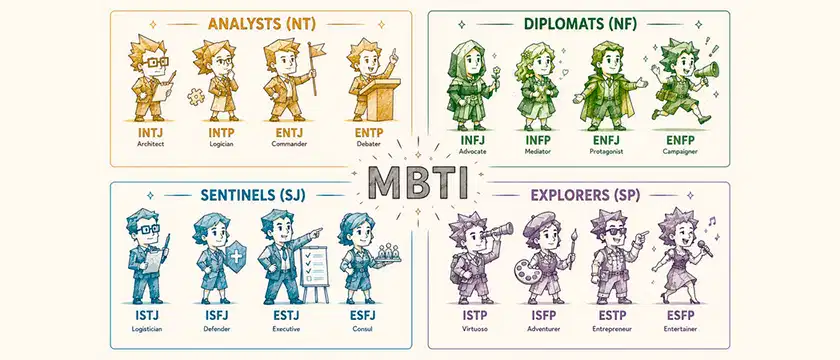
How MBTI and careers are connected
MBTI describes preferences across four scales: where someone tends to focus their attention and get energy—from within or through interaction with the world; what they rely on when taking in information—concrete facts or possibilities; how they make decisions—through logic or by considering values and people; and which approach to external matters feels more comfortable—structured or flexible.
Combining these preferences gives you a four-letter type. It can suggest questions for self-reflection, but it doesn’t measure professional ability or predict success at work. A test result isn’t a substitute for consulting a mental health professional.
Think of the recommendations below as options to explore. Working conditions can vary widely within the same profession: software development in a small team and working at a large company with frequent approvals call for different levels of interaction. Skills, experience, interests, salary, and learning opportunities matter, too.
Careers for each MBTI type
Analysts: INTJ, INTP, ENTJ, ENTP
INTJ. You may be drawn to tasks that involve understanding a complex system and creating a long-term plan: systems architecture, research, financial analysis, or strategic planning. For example, a systems architect figures out how different parts of a product will work together. It’s worth finding out in advance how much of the role involves independent analysis and how much involves getting approvals.
INTP. Fields that involve exploring ideas and finding explanations are often appealing: programming, data analysis, scientific research, and software testing. For example, an analyst might look into the cause of an unexpected change in metrics by testing several hypotheses. Find out whether you’ll have time for focused work or whether your day will mostly consist of urgent requests.
ENTJ. You could explore project management, entrepreneurship, operations management, or business consulting. These roles involve setting goals, allocating resources, and making decisions. For example, a project manager organizes a product launch. As you consider a role, think about whether you’re ready not only to set direction, but also to listen to the team, work through constraints, and adjust the plan.
ENTP. Possible areas to explore include product development, entrepreneurship, marketing strategy, and user experience research. These roles can involve proposing hypotheses and testing different approaches. For example, a product manager compares several ways to solve a customer’s problem. Be sure to consider the routine side of the role, too: documentation, deadlines, and seeing decisions through to completion.
Diplomats: INFJ, INFP, ENFJ, ENFP
INFJ. Education, user research, editing, or nonprofit projects may be a good fit—especially if you want to understand how your work affects people. A user researcher, for example, talks with customers and helps the team improve a service. Check whether the role leaves enough time for analysis and how much interaction it involves.
INFP. Consider editing, illustration, education, and cultural or social projects. These fields can offer room for creativity and the chance to work on a subject you find meaningful. For example, an editor helps an author make a complex text easy to understand. Even creative work, though, usually involves revisions, constraints, and discussing decisions.
ENFJ. Areas to explore include adult education, team management, employee development, and coordinating social programs. For example, a learning and development specialist identifies a team’s needs and organizes training. The work involves plenty of interaction, but also requires planning, giving feedback, and being willing to discuss difficult issues.
ENFP. You may be interested in communications, event planning, developing educational products, and community work. For example, a community manager comes up with event formats and finds out what matters to members. Before choosing a role, find out how much freedom you’ll have to pursue new ideas and who handles schedules, budgets, and recurring tasks.
Organizers: ISTJ, ISFJ, ESTJ, ESFJ
ISTJ. You could look into accounting, quality control, logistics, or process administration. These fields often call for accuracy, following rules, and carefully checking details. For example, a logistics specialist makes sure a shipment arrives on time. Find out how stable the processes are and how often you’ll need to respond to unexpected changes.
ISFJ. Options to explore include library work, administrative support, education, and customer service coordination. For example, an administrator at a learning center helps people with schedules and paperwork. It’s worth considering not just whether you like helping people, but also the workload: the volume of requests, working hours, and support from the team.
ESTJ. You may be interested in operations management, logistics, project management, or production planning. For example, an operations manager tracks deadlines and helps coordinate processes across departments. It’s useful to find out in advance what authority the role comes with and whether you’ll have to make decisions independently when information is limited.
ESFJ. Consider customer service management, event planning, training, or team coordination. For example, a customer support specialist helps resolve a problem and passes feedback along to colleagues. Check whether you’re comfortable with constant interaction and whether responsibilities are clearly defined in challenging situations.
Explorers: ISTP, ISFP, ESTP, ESFP
ISTP. Engineering, technical diagnostics, equipment repair, and software development are all worth exploring. For example, an engineer finds the cause of a malfunction and tests a solution in practice. Consider the conditions of the specific job: sometimes there’s less hands-on technical work than reporting, meetings, or communication with clients.
ISFP. Possible areas include graphic design, photography, applied arts, and landscape design. For example, a designer chooses a visual solution to meet a client’s needs. Creative work can also involve budget constraints and revisions, so it may help to try a small project and see whether you enjoy the whole process.
ESTP. You could explore sales, event planning, entrepreneurship, or customer-facing roles involving technical products. For example, a sales specialist finds out what a client needs and suggests a suitable solution. Ask how performance is measured, how often you’ll need to respond to unexpected situations, and what your income depends on.
ESFP. Options to explore include event planning, community work, teaching practical skills, and hospitality. For example, an event organizer makes sure guests are comfortable and the program stays on track. Find out whether the schedule works for you: people-focused jobs can sometimes involve evenings, weekends, and busy periods.
Jobs for INTPs: where to start
If your result is INTP, try searching not only by job title, but also by task: building a model, finding an error, testing a hypothesis, or explaining a complex system. You’ll find these tasks in data analysis, programming, research, engineering, and technical testing. Each field calls for different knowledge, so your type can’t replace looking into job requirements.
Say you’re interested in data analysis. Before signing up for an expensive course, find an open dataset, come up with one question, and try to answer it using a spreadsheet. Did you enjoy not only finding patterns, but also explaining your conclusions? If so, look into the tools you’ll need and the requirements for entry-level roles.
Consider the work environment, too: even a research role may involve presentations and discussions. And if you enjoy interacting with people, an INTP result isn’t a reason to rule out customer-facing or management roles.
How to test a career idea in practice
- Choose two or three roles. Compare more than just job titles: look at the day-to-day responsibilities in job listings. What does someone spend most of their week doing? What tools do they use, and who do they work with?
- Try a small experiment. Do a practice project, attend an open class, help a project you know with a task, or talk to someone in the field. Ask what surprised them about the work.
- Think about the conditions. Write down your desired income, preferred schedule, willingness to learn, and need for interaction. For example, you might enjoy the tasks in a customer-facing job but find that evening shifts don’t work for you.
- Compare several sources. The Career Choice Test suggests fields and ways to try them out, while the Holland Code test offers another perspective on your professional interests.
If your main questions are about the work environment, take the “Am I an Introvert or an Extrovert at Work?” test. Compare your result with your own experience: which meetings, tasks, and workdays leave you with energy?
Frequently asked questions
Can you choose a career based only on MBTI?
It’s best not to rely on type alone. It can give you ideas to reflect on, but it doesn’t show your skill level, the conditions of a particular job, or its earning potential. Try out your interest in practice and look into what employers require.
Can introverts work with people?
Yes. The kind of interaction matters: one-on-one consultations, teaching a small group, and nonstop negotiations can feel very different. Look for a comfortable pace of interaction and time to recharge.
What if a career doesn’t match your type?
Don’t rush to change anything. Look at the actual tasks, working conditions, and what you’ve already learned. A list of matches doesn’t rule out working in a field that interests you or developing the skills it requires.
Can your MBTI result change?
Your result may differ if you take the test again, especially if your preferences on one of the scales aren’t strongly pronounced. Treat it as a prompt to examine your own observations, not as a final label.
What’s next?
MBTI can help you come up with career hypotheses, while real-world tasks can help you test them. Take the main test, choose a couple of fields that interest you, and find a low-risk way to try each one.
For a broader picture, explore other tests about careers, interests, and work environments: