How to prepare for the MBTI test
First, choose a quiet moment when you won’t have to rush through the questions or keep getting interrupted. Tiredness, a recent argument, or a stressful week at work can make some situations stand out and overshadow others. You don’t need to wait until you’re in the perfect mood: just take stock of how you’re feeling, and don’t judge your whole life based on today alone.
Before you begin, make one rule for yourself: answer based on your usual behavior, not the role you have to play. At work, you might lead meetings and make quick decisions because that’s what the job requires. At home, you might prefer quiet and time to think. Both observations matter, but it’s best to consider your preferences beyond the scope of a single job.
If a question seems too broad, mentally add “most of the time” or “when I have a choice.” For example, when answering a question about socializing, it’s more useful to think about several ordinary get-togethers than one great party. After those events, did you want to keep talking or spend some time on your own?
Don’t try to figure out your ideal type in advance. A description like “the strategist” or “the diplomat” may sound appealing, but choosing answers to get the letters you want defeats the point of the test. Save the detailed descriptions for later. That way, it’s easier to notice your own preferences instead of trying to fit a flattering image.
How to answer honestly when the options feel debatable
Many test questions ask you to choose between two extremes. In real life, though, people can act in different ways. To avoid getting stuck on every question, try a few simple approaches.
- Look for patterns. If you sometimes plan a trip in detail and sometimes pull it together in an evening, think about your last few trips. Which approach did you choose more often when you were free to decide?
- Separate ability from preference. You may be good at speaking to an audience thanks to practice, without necessarily enjoying spontaneous socializing. It matters not only what you can do, but also which approach feels more natural.
- Don’t confuse wanting to change with describing yourself. Wanting to become more organized doesn’t mean you usually plan every task in advance. Answer based on your current habits, and note your development goals separately.
- Think about what you do, not how people see you. Others may think you’re calm because they don’t see the tension you feel inside. Think about how you experience a situation and what you do when nobody is judging you.
- If it’s a tie, choose the closest option. If there’s a neutral answer and it genuinely fits, use it. If not, compare specific examples and go with the slight edge. Don’t try to make every answer perfectly precise.
It also helps to check the context of a question. “I enjoy discussing ideas” doesn’t necessarily mean “I want to talk to everyone”—you might enjoy a long conversation with one close friend. And “I prefer having a plan” doesn’t mean every surprise makes you uncomfortable. Answer what the question actually asks without reading more into it than necessary.
If you’re unsure about nearly every answer, don’t turn the test into an exam. Make a note of the questions that gave you pause and come back to them when reviewing your result. Uncertainty may mean your behavior depends on the situation or that the question wasn’t specific enough for you.
What the four letters and 16 personality types mean
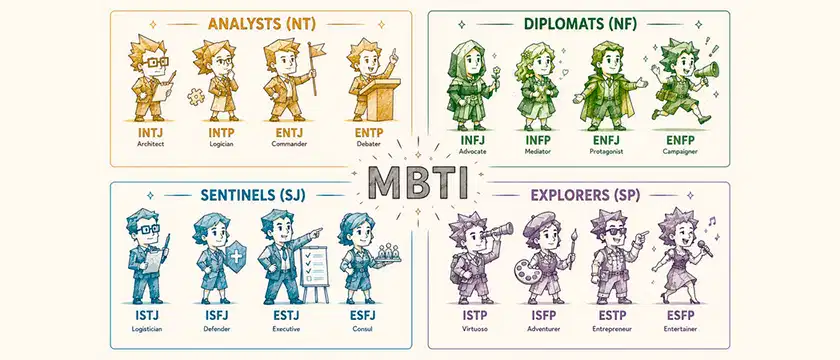
The MBTI describes preferences across four pairs. Their combinations make up 16 personality types, such as INTJ, ESFP, or INFP. Each letter represents one end of a scale, but that doesn’t mean you’re unable to use the opposite approach.
- E and I — extraversion and introversion. This scale is about where you tend to direct your attention and how you interact with the outside world. One person may work out their thoughts by talking, while another prefers to think them through first. Being sociable doesn’t determine your letter by itself: your usual way of interacting and how you recharge afterward also matter.
- S and N — sensing and intuition. This pair is about the kind of information you tend to rely on. When choosing a new route, one person might first check the timetable and distance, while another focuses on the possibilities and the overall picture of the trip. N stands for intuition because I is already used for introversion.
- T and F — thinking and feeling. This pair describes your preferred approach to decisions: relying on consistency and logic, or paying particular attention to values and how people may be affected. Choosing T doesn’t mean you lack empathy, and choosing F doesn’t mean you lack logic. Important decisions usually call for both weighing the consequences and considering the human side.
- J and P — judging and perceiving. This scale is about how you prefer to organize your outer life: deciding on a course of action in advance or leaving more room for change. It doesn’t measure intelligence, responsibility, or your ability to meet deadlines.
For example, the letters in INFP point to preferences for introversion, intuition, feeling, and perceiving. It’s a shorthand, not a complete description of a person. Two people with the same letters can have different habits, interests, and experiences. If you’re curious about social interaction in particular, try the social energy test for another perspective.
How to identify your MBTI type and check your result
Once you have your four letters, don’t stop at the type name. Look at each scale separately: what two or three familiar situations support your result, and what situations don’t fit? For example, you might plan ahead at work but not when deciding how to spend your free time. That doesn’t necessarily disprove your result; it can help you see where your usual approach applies.
Next, read the description without trying to recognize yourself in every sentence. Note specific observations: “I find it helpful to write down my thoughts before discussing them” is more useful than “I’m a complicated person.” Pay attention to what doesn’t fit, too. If the description says you always avoid change, but you often seek it out, there’s no need to bend your memories to fit the wording.
If your result seems borderline or surprising, take the test again later in an ordinary setting and compare your answers on the scales you weren’t sure about. Don’t keep retaking it until you get the code you want. Instead, ask yourself whether your circumstances, mood, or understanding of the questions have changed. You can talk through your observations with someone you trust, but their opinion doesn’t have to decide the matter for you.
The model has its limitations: personality traits don’t always fit neatly into two categories, and results can change when you take the test again. Also, an online test based on the MBTI isn’t necessarily the official Myers-Briggs questionnaire. Use your result as a tool for reflection, not as a basis for choosing a career, judging a relationship, or drawing conclusions about your abilities. A test can’t replace advice from a mental health professional.
The MBTI grew out of ideas about psychological types associated with Carl Jung’s work, but it isn’t the same as every interpretation of his theory. To compare approaches, try the Jungian theory test and pay attention to the questions, not just the final type name.
Frequently asked questions
Can I take the MBTI test for someone else?
You can guess how they might answer, but the result will reflect only your view of their behavior. For a more meaningful result, it’s best for them to answer the questions themselves.
Why did I get a different type when I took the test again?
Your circumstances, interpretation of the questions, or answers close to the middle of a scale may have affected the result. Compare not only the final letters, but also the situations you had in mind when answering.
Which of the 16 personality types is the best?
There’s no best type. The code doesn’t measure a person’s worth or guarantee success at work or in relationships. Every approach has strengths and limitations depending on the situation.
Can you identify an MBTI type from a single trait?
No. Even a strong love of socializing isn’t enough to reliably identify all four letters. Consider each pair of preferences separately and check your conclusions against different examples.
What to do next
Take the main MBTI test, answering based on your usual behavior, then use your result as a starting point for observation. Compare the description with your real life, and give yourself permission to disagree with some of its conclusions.
If you’d like to explore the topic from other angles, browse this collection of tests: