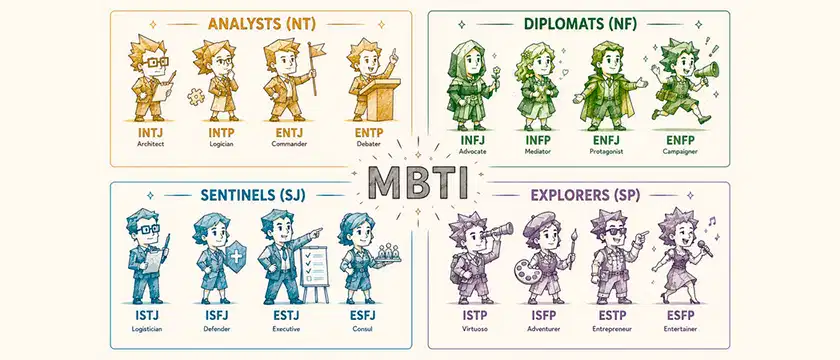
What the MBTI Scales Mean for Compatibility
The MBTI describes preferences across four pairs of scales. These aren’t abilities or rigid categories: people may act differently depending on the situation. Still, the scales offer a useful way to talk about everyday habits.
- I and E — introversion and extraversion. After a busy day, one person may need quiet while another would rather meet up and talk. Try not to mistake a need for solitude for hurt feelings, or a desire to socialize for pressure.
- S and N — sensing and intuition. One approach focuses more on concrete facts and details, the other on ideas and possibilities. When planning a trip, one person might check the timetable while another suggests an unexpected route.
- T and F — thinking and feeling. When making decisions, the focus may be on consistency and criteria, or on values and how the decision affects people. Both approaches can take feelings and reason into account.
- J and P — preference for structure and flexibility. Some people feel more at ease agreeing on a plan ahead of time; others are happier leaving room for changes. Disagreements often stem not from the plan itself, but from different expectations.
Similarities can make some conversations easier, while differences can complement each other. But neither similarity nor opposites guarantee closeness. Use the letters as conversation starters, not labels: “Is that what works best for you?” is more helpful than “You always do that.”
Compatibility Across the 16 Personality Types: What to Consider
These aren’t rankings of the best matches, but conversation starters. The descriptions are intentionally brief: not everyone will recognize every trait associated with their type. The pairings below suggest possible points of connection, not the only suitable partners or friends.
Analysts: INTJ, INTP, ENTJ, ENTP
- INTJ may value independence and conversations about long-term goals. An INTJ might enjoy exchanging ideas with an ENFP or ENTP; it can help to talk about how much spontaneity feels comfortable for each person.
- INTP may enjoy exploring complex questions without rushing. An INTP and INTJ might like delving into a topic together, while an ENTP can bring unexpected angles to the conversation. In close relationships, it helps to express important feelings rather than leaving them between the lines.
- ENTJ may prefer clear goals and decisive action. An ENTJ might have a productive exchange of strategies with an INTJ or INTP, as long as every conversation doesn’t turn into a problem that needs solving right away.
- ENTP may enjoy fresh ideas and friendly debate. A conversation with an INFJ or INTJ can be engaging, but it’s worth checking whether the other person is up for a discussion or looking for support.
Explorers: ISTP, ISFP, ESTP, ESFP
- ISTP may prefer tackling practical problems and having personal space. With an ESTJ or ESFJ, it helps to be clear about when advice is welcome and when you’d rather figure things out on your own.
- ISFP may value freedom of choice and low-key support. With an ENFJ or ESFJ, it’s best to state your preferences directly: the same gesture of care may not mean the same thing to both people.
- ESTP may enjoy taking action and making quick decisions. With an ISTJ or ISFJ, finding a balance between spontaneity and predictability can help—for example, agreeing on a trip budget in advance.
- ESFP may enjoy sharing new experiences. With an ISTJ or ISFJ, it can help to agree on which plans to make ahead of time and what can be decided on the day.
Any of these types can be friends or partners with any other type. If your pairing isn’t in the examples, that says nothing about its potential: compare the habits and needs of the people involved.
The Best Match for an INTJ: Is There a Clear Answer?
There’s no single best match for an INTJ. ENFPs and ENTPs are often named in popular discussions: the idea is that their interest in new ideas may complement an INTJ’s tendency to plan and analyze. That’s one possible scenario, not a rule or a scientific prediction of compatibility.
Imagine a weekend away: someone with INTJ preferences wants to book accommodation ahead of time and leave the evening free, while someone with ENFP preferences suggests inviting friends and choosing a route on the day. Both wishes matter. A compromise could be to book the accommodation in advance, leave the first half of the day open to spontaneous ideas, and save the evening for time together.
With another INTJ, it may be easier to agree on quiet time and independence, but similar preferences don’t remove the need to talk about feelings. With an ESFP, there may be more new experiences, though you’ll need to work out a rhythm and approach to planning that suit you both. In friendships, the same questions come up around how often to meet, how much to text, and what kind of support to expect.
Rather than searching for a perfect code, ask yourself: Can you disagree calmly with this person? Do you keep the agreements you make? Is there room for both shared interests and time apart? The answers will tell you more about a relationship than four letters ever could.
How to Use MBTI in Relationships and Friendships
The framework is useful when it helps you clarify habits—not when it explains everything someone does. Try using differences as a starting point for specific agreements.
- Talk about time together and time to recharge. Instead of saying, “You’re avoiding me,” try: “I’d like to talk after work. How often works for you?” You could agree on a quick check-in and set aside separate time for a longer conversation.
- Ask what kind of response would help. If a friend tells you about a difficult day, ask: “Would you like advice, or would you rather I just listen?” That way, a practical response is less likely to come across as indifference.
- Agree on how to make plans. For a trip together, you could settle the budget and dates in advance, then choose a café when you get there. That gives structure to people who like certainty and flexibility to those who prefer to keep their options open.
- Talk through conflict using specifics. Instead of saying, “You’re that type, so you don’t know how to listen,” describe what happened: “I felt hurt when the plans were canceled at the last minute. Let’s give each other more notice next time.”
MBTI preferences aren’t the only thing that shapes how close people feel. For example, one person may show care by helping around the house, while another especially values kind words. To explore that difference, take the love language test and compare your answers without expecting them to match.
If distance or waiting for a reply causes a lot of anxiety in a relationship, the attachment style test may offer another point to reflect on. The partner compatibility test can help you think about how well you understand each other, how you handle conflict, and where your boundaries lie. Tests aren’t a substitute for professional advice.
Frequently Asked Questions
Can MBTI alone tell you whether a couple is compatible?
No. MBTI describes preferences, but it can’t reliably predict the quality of a specific relationship. Pay attention to trust, respect for boundaries, and how you work through disagreements.
Are opposites always attracted to each other?
No. Differences can spark interest and broaden your experience, but they may also call for extra communication. People with similar preferences can have a great relationship, too—or run into difficulties unrelated to their type.
Can two introverts be a good match?
Yes. For example, both may enjoy spending time together in a relaxed setting. But their needs for closeness, how often they want to connect, and how they prefer to discuss problems may still differ.
Are MBTI and socionics the same thing?
No. They’re different personality frameworks with their own models and labels. Don’t automatically apply compatibility advice from one system to the other, or assume that type names are fully interchangeable.
What to Take Away
It’s best to think of compatibility across the 16 personality types as a set of topics to talk about, not a list of pairings that are allowed or off-limits. Take the MBTI test, find out your result, and talk with people close to you about which habits really fit.
These other tests can help you explore relationships further: