What does it mean for an MBTI type to be rare?
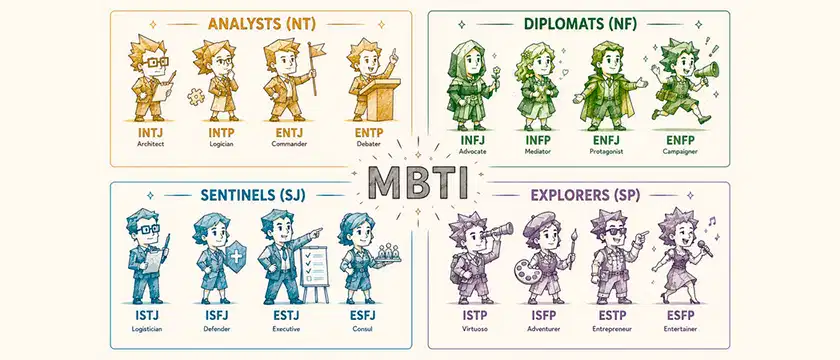
MBTI describes personality preferences across four pairs: introversion and extraversion, intuition and sensing, thinking and feeling, and judging and perceiving. They’re represented by the letters I and E, N and S, T and F, and J and P. These combinations make up 16 types. For example, INFJ combines the preferences I, N, F, and J.
These pairs don’t mean that a person is only capable of one thing. An introvert may enjoy speaking in front of an audience, and someone with a preference for thinking may be deeply considerate of other people’s feelings. The pairs are better understood as someone’s usual way of directing their attention, gathering information, making decisions, and organizing their life.
When a type is called rare, it usually means that a small share of people in a particular study or survey got that result. But the people who take an online quiz may differ from the population as a whole: those interested in the topic are more likely to take it. What’s more, different tests ask different questions and may draw the line between preferences in different places.
That’s why a type’s exact place in a ranking isn’t universal. Without information about the sample and methodology, the claim that “this is the rarest personality type in the world” sounds more certain than the evidence allows. It’s more accurate to say that some combinations are less common than others in certain samples.
Which personality types are considered rare?
Here are some types that often come up in discussions about rarity. This isn’t a definitive ranking: the order varies depending on the source. These descriptions can help you picture the preferences, but they don’t predict how every person with that result will behave.
INFJ: Attentive to people and the bigger picture
If you’ve searched for “INFJ rare type,” you’ve probably come across descriptions of INFJs as thoughtful and values-driven. In MBTI, INFJ is associated with an interest in the meaning behind things, attentiveness to people, and a desire to understand where their actions are leading.
For example, during a work discussion, someone with this result might quietly weigh up different ideas before suggesting a solution that takes into account both the project’s goals and the team’s relationships. But an INFJ doesn’t have to be constantly reading other people’s feelings or avoiding disagreements. Four letters don’t give anyone superpowers or make them immune to ordinary mistakes.
ENTJ: Strategy and organization
In MBTI, ENTJ is associated with extraversion, an interest in possibilities, logical analysis, and a preference for structure. This profile is often described in terms of a drive to organize tasks and work toward results.
Imagine planning a group event: someone with ENTJ preferences might suggest dividing up responsibilities, setting deadlines, and checking the budget. But that doesn’t mean every ENTJ dreams of being in charge or is always confident. Behavior depends on experience, circumstances, and personal goals.
INTJ: Independent analysis and planning
INTJ is usually described as a combination of introversion, intuition, thinking, and judging. In popular interpretations, this type is associated with independent analysis, spotting patterns, and keeping an eye on long-term results.
For example, before buying a new piece of tech, someone with this type might make a list of requirements, compare several models, and think ahead to how they’ll use the device in a couple of years. But a love of planning doesn’t make an INTJ cold or incapable of spontaneity: it’s simply a general picture of preferences, not a description of every part of someone’s life.
ENFJ: Connecting with others and working toward a shared goal
ENFJ is associated with communication, an interest in possibilities, attention to values, and an organized approach. In a group project, someone with this result might notice that one person hasn’t had a chance to speak and suggest a format that gives everyone a chance to be heard.
That doesn’t automatically make an ENFJ the perfect leader or psychologist. As with any type, communication skills develop with practice, and being willing to help doesn’t mean you have to take on other people’s responsibilities.
What about the other types?
Different rankings may also identify other combinations as rare, including some types with preferences for intuition or introversion. Without comparable data, it’s impossible to confidently rank all 16 types. But you can compare the descriptions and notice which habits really sound like you—and which don’t.
How these differences show up in everyday life
MBTI descriptions become more useful when you test them against real situations rather than appealing labels. Try to think not of one unusual day, but of what you usually choose when you have room to decide.
- After socializing. Do you recharge more easily in quiet, or do you want to talk through your experiences with other people? Enjoying good company isn’t exclusive to extroverts; introverts can enjoy it too. Take our social energy test to explore this side of yourself.
- When learning something new. Do you look for clear instructions and examples first, or would you rather understand the general idea and its possibilities? Both approaches are useful: one helps you catch the details, while the other helps you see the connections.
- When making a decision. Do you start by checking whether the arguments make sense, or by considering how the decision fits with your values and affects other people? In practice, both often matter.
- When making plans. Do you feel more at ease agreeing on a travel route in advance, or leaving room for changes along the way? Preferring flexibility doesn’t mean being irresponsible, and liking a plan doesn’t rule out improvisation.
Pay attention to the context, too. At work, you might stick to a schedule because that’s what the team needs, but prefer an unplanned day on vacation. A test can’t always distinguish a personal preference from a learned habit or external expectations. So it can help to ask yourself: “What would I do if I could choose without pressure?”
What to do if you get a rare type
Don’t rush to change how you see yourself based on a single result. An online test is a useful starting point for reflection, but it isn’t a precision instrument that defines your personality once and for all. Here’s how to get more out of it.
- Read what each letter means. Look beyond the overall INFJ or INTJ profile and check the individual preferences, too. If most of the description doesn’t resonate, take the result with particular caution.
- Think of examples from different parts of your life. Compare how you act at home, in school, and at work. Do you consistently prefer to plan, or do you only do it when the cost of a mistake is high?
- Look at a neighboring type. If both INFJ and INFP seem to fit, explore how J and P differ in the model. You don’t have to choose one letter right away: your habits may not point clearly in one direction.
- Come back to the questions later. If you took the test in a hurry or answered the way you thought you “should,” try again when you’re more relaxed. A different result is a reason to look more closely at your answers, not proof that your whole personality has changed.
- Put what you’ve learned to use. For example, if you notice that you need a break after a busy round of socializing, try making time for one. The value of that insight doesn’t depend on how rare your four-letter code is.
For another perspective on a related topic, try our Jungian theory test: it explores thinking, feeling, sensation, and intuition. But Jungian-style results and MBTI results shouldn’t automatically be treated as the same thing.
It’s also worth remembering the model’s limitations: personality is more complex than four pairs of preferences, and scientific psychology uses other ways to describe it, too. A test isn’t a substitute for consulting a mental health professional.
Frequently asked questions
What is the rarest personality type?
INFJ is often called the rarest, but there’s no single answer that applies to everyone. A type’s place in the ranking depends on the sample and how the type was identified; ENTJ, INTJ, and ENFJ are also often considered rare.
Why can MBTI results vary?
Tests differ in their questions and scoring rules. Your answers matter, too: for example, it can sometimes be hard to separate your usual behavior from what a situation calls for.
Does having a rare type mean you’re special?
Not in the sense of being better than other people. Rarity only tells you how often a combination appeared among those surveyed; by itself, it says nothing about a particular person’s talents or character.
Can your personality type change?
Your test result can change, partly because of differences in the questions and your answers. People also develop new habits and skills, so it’s more useful to observe yourself than to treat a code as an unchanging trait.
What to know about rare MBTI types
INFJ often appears on lists of rare types, but what matters more than its place in a ranking is what you can learn about yourself. Take the main MBTI test and compare the result with your own experience—without feeling you have to fit the description.
If you’d like to explore other sides of yourself, try this collection of tests, too: