What Is Wu Xing, and What Does It Have to Do with Personality?
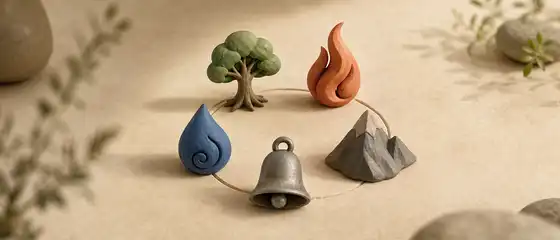
Wu Xing is often translated as “the five elements,” but “phases” better conveys the idea of movement and change. In traditional Chinese thought, the framework was used to observe nature, the seasons and various processes. For example, Wood is associated with spring growth, while Water is linked to conserving energy in winter.
The elements in Chinese philosophy don’t quite match the familiar Western set of earth, water, air and fire. Here, there’s Metal and Wood, but no Air. Earth can also mean more than soil: in the Wu Xing system, it’s associated with the center and with transitions between states.
When these images are used to talk about personality, they offer a handy language of metaphor. Wood can prompt you to think about initiative, Metal about boundaries, and Water about adaptability. That doesn’t mean people are literally made up of five energies or have to behave according to a single description.
This framework can suggest questions for self-reflection, but it isn’t a scientific way to measure personality. The quiz is not a substitute for consulting a mental health professional.
The Five Elements of Wu Xing: How They Show Up in Life
Here are some modern interpretations of the elements as images of behavior. Different traditions and schools may emphasize different things. Read these not as a diagnosis or a strict list of traits, but as a chance to notice familiar situations.
Wood: Growth and Moving Forward
Wood is associated with development, initiative and the drive to find a direction. If this image resonates with you, you may enjoy starting projects, learning new skills and spotting opportunities for change. For example, when you notice an inefficient process at work, you suggest a plan and try to improve it.
The strength of this approach is its ability to get things moving. One possible challenge is feeling frustrated when others would rather move more slowly or when a plan needs to change. A useful question to ask yourself: am I still growing, or am I just pushing forward at any cost?
Fire: Enthusiasm and Connection
Fire is associated with warmth, self-expression and lively exchange. This image may remind you of someone who enjoys bringing people together, sharing ideas and setting the mood. At a gathering with friends, for example, you might suggest a game, draw quieter people into the conversation and get everyone talking.
This energy can help you inspire others and express your feelings openly. But constant intensity can wear you and the people around you out. If you want to cancel all your plans after a packed day, that doesn’t contradict the Fire image: even the liveliest social life needs a pause.
Earth: Support and Care
Earth symbolizes stability, practicality and attention to what keeps everyday life running. It’s not just about liking familiar routines; it can also mean being ready to make things easier for others. Say you’re planning a family trip: you check the route and departure time, and make sure there’s enough room for everyone.
This approach helps you notice people’s real needs and get everyday tasks done. The flip side is taking on too much or avoiding necessary changes to keep things calm. Sometimes caring for a group starts with asking: who else can share the responsibility?
Metal: Clarity and Boundaries
Metal is associated with structure, precision and the ability to separate what matters from what doesn’t. This image may resonate with you if you value clear agreements, spot inconsistencies and know how to see things through. For example, before a group project begins, you suggest agreeing on deadlines, roles and what counts as finished.
Metal’s strength is its ability to bring order to situations full of uncertainty. One possible challenge is being too demanding: not every mistake needs to be fixed immediately, and not every rule fits a new situation. Boundaries work best when there’s room for discussion.
Water: Adaptability and Observation
Water is associated with depth, adaptability and the ability to conserve resources. This image may resonate with you if you prefer to gather information, take in what’s happening and choose the right moment before making a decision. During a disagreement, you first try to understand what’s really bothering each person rather than jumping straight to an answer.
This style can be useful when a situation is complicated and pressure only gets in the way. But taking time to observe can sometimes turn into procrastination. If the options keep multiplying, try setting a deadline for your decision and figuring out what information you actually still need.
How the Elements Interact
Wu Xing is interesting not only for its individual images, but also for the connections between them. In one of its main cycles, the phases generate one another: Wood feeds Fire, Fire creates Earth, Earth gives birth to Metal, Metal generates Water, and Water nourishes Wood. This is a traditional system of correspondences, not a guide to describing physical processes.
Another cycle is called the cycle of overcoming or control: Wood restrains Earth, Earth restrains Water, Water restrains Fire, Fire restrains Metal, and Metal restrains Wood. To remember it, picture water putting out a flame or a metal tool cutting wood. The point isn’t a battle between good and bad, but mutual limits and change.
You can picture how this works in life like this: the idea to start something new resembles the impulse of Wood; inspiring a team, Fire; allocating resources, Earth; setting clear rules, Metal; and taking a pause to reflect, Water. One person may need all these approaches in a single project.
That’s why it’s best to think of your quiz result as a snapshot of your usual approach, not a lifelong affiliation with one element. You might look for clear boundaries in a work disagreement, but prefer quiet observation and no schedule when you’re relaxing.
How to Find Out Which Element You Are
Instead of starting with the description that sounds most appealing, think of a specific recent situation. How did you react when plans suddenly changed? Did you suggest a new approach right away, lift the group’s spirits, take care of practical details, clarify the rules or take some time to think?
Then check your first impression against a few different situations:
- Decisions. What matters most to you at the outset: room to grow, people’s enthusiasm, a solid foundation, clear criteria or time to figure things out?
- Conflicts. Are you inclined to push for a solution, talk about feelings, find common ground, set boundaries or observe first?
- Relaxing. Do you recharge through new experiences, socializing, familiar comforts, getting organized or quiet time without a strict plan?
- Change. Do you try to initiate it, inspire others, maintain stability, structure the process or adapt as you go?
Your answers may vary depending on the circumstances. For example, you might rely on rules at work but easily change plans at home. That’s a normal limitation of any short typology: context also affects behavior. If you want to check your first impression, jot down a couple of examples over the course of a week and see which approach keeps coming up.
This 15-question quiz offers one way to reflect on yourself and shows which image stands out most in your answers. It doesn’t calculate your element from your date of birth. Some Chinese traditions use calendar information, including the date and time of birth, in their readings, but that’s a different approach; identifying someone’s element by birth year alone would be an oversimplification.
For comparison, try the Jungian personality quiz: it offers a different way to talk about perception and decision-making. The quick socionics quiz introduces another typological model. Similarities between the results may be interesting, but the systems don’t have a direct one-to-one correspondence.
Frequently Asked Questions
Which element is considered the strongest?
There’s no universally best element in Wu Xing. Each image has useful qualities and possible limitations; a lot depends on the situation and how someone acts.
Can more than one element fit me?
Yes. You may recognize yourself in different descriptions and show different qualities depending on the task. The quiz highlights the most noticeable tendency in your answers; it doesn’t rule out the others.
Can my zodiac sign tell me my element?
Your usual Western zodiac sign doesn’t determine the result of this quiz. Chinese calendar systems work differently and follow their own rules; our quiz is based on your answers about behavior.
Can my result change over time?
It can: habits, circumstances and even the way you understand the questions aren’t always the same. If you take the quiz again later, compare not just the element name, but also the situations you had in mind when answering.
See Yourself Through the Images of Wu Xing
The five elements of Wu Xing offer different ways to describe initiative, connection, care, order and adaptability. Take the main quiz to find out which image is closest to the way you act right now.
If you’d like to explore other approaches and fun formats, check out this collection: