How the Game Works: The Rules of Season One
In the first season, 456 people facing serious financial hardship are invited to take part in a series of games. The prize pool grows as contestants are eliminated, and the winner is promised an enormous sum. But behind the seemingly familiar children’s games lies the real catch: elimination means death.
The organizers present the competition as a level playing field. Contestants wear identical clothes and learn the rules just before each challenge. But formal equality doesn’t make the situation fair: people have different physical abilities, knowledge, and connections, while the organizers control the information.
The first season features six main challenges:
- “Red Light, Green Light.” Contestants must move toward the finish line and freeze whenever the doll turns to face them. A mistake or a moment of panic can cost them their lives.
- Dalgona. Contestants must cut a designated shape out of a fragile sugar candy. They choose a shape before they know what the choice means.
- Tug-of-war. Teams compete above a drop. Strength matters, but so does working together.
- Marbles. Contestants pair up, only to discover that they’ll have to compete against each other. That’s what makes the trust they’ve built so painful.
- The Glass Bridge. Contestants must choose safe panels and make it to the other side. The order they go in has a major impact on how much information they have and how much risk they face.
- Squid Game. The final challenge is based on a Korean children’s game involving attack and defense on a court shaped like a squid.
There’s also an important rule about consent: the game can be stopped if a majority agrees. Early in the season, the contestants vote to end it and return home. But their debts and desperation haven’t gone away, so many decide to come back. The scene raises a question: how free is a choice when the available alternatives seem unbearable too?
What Does Squid Game Mean?
The series sets children’s games against the adult struggle to survive. In an ordinary game, you can lose, feel upset, and try again. Here, a mistake is final, and the familiar rules make everything even more unsettling: viewers recognize a simple game, but see a world where safety has disappeared.
Inequality is another central theme. The contestants enter the game for different reasons, but the system reduces their stories to numbers. The wealthy spectators, meanwhile, can treat other people’s danger as entertainment. This contrast highlights the divide between those risking their lives and those for whom the risk is just a spectacle.
At the same time, the series doesn’t suggest that poverty automatically makes someone kind or cruel. The characters behave in different ways: they help, deceive, sacrifice themselves, or change their minds. Character matters, but so does the situation—one in which choices must be made quickly and with little reliable information.
A similar tension can arise outside the screen, though it can’t be compared with a threat to life. For example, a competition at work for a single bonus might lead colleagues to withhold useful information, even if they’re usually happy to help one another. Rules don’t entirely determine behavior, but they create incentives that people respond to.
If you’re interested in comparing dystopian characters, try the quiz “Which Hunger Games Character Are You?”. It’s a fun way to think back on how other characters act in competitions under public scrutiny.
Squid Game Symbols: Shapes, Colors, and Spaces
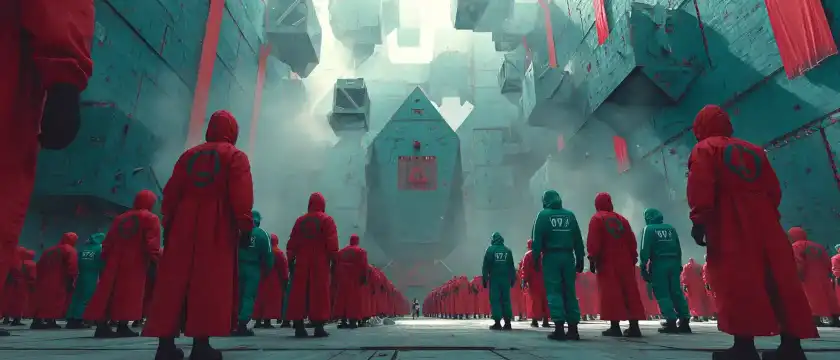
The most recognizable symbols in Squid Game are the circle, triangle, and square. They appear on the guards’ invitations and masks. For the guards, the shapes help distinguish ranks: the circle is associated with workers, the triangle with armed guards, and the square with managerial roles. The masks hide their faces, so each person is seen first and foremost as part of the system.
The shapes can also be read more broadly: they’re simple symbols familiar from childhood. Against the bright sets, they bring to mind building blocks or a playground, while also signaling strict order. There’s no need to look for one hidden meaning for each shape: their power lies in the contrast between their simplicity and the brutality of what’s happening.
Clothing colors also distinguish different roles. Green tracksuits unite the contestants, while pink uniforms identify the staff. Numbers help the organizers keep track of the players, but for viewers they also serve as a reminder of lost individuality. The more we learn about the person behind a number, the sharper that contrast becomes.
The doll and the playground combine childlike aesthetics with surveillance and punishment. The doll doesn’t look like a conventional armed opponent, yet it’s the one watching the contestants’ every move. Danger appears where viewers expected to find a toy.
Staircases and corridors evoke a bright maze. The contestants are constantly led along a set route: they see individual rooms but have no control over how the whole complex is laid out. In everyday life, you might feel something similar when filling out a confusing application: each step is clear, but the full consequences of your choices aren’t. Of course, the comparison is only about the feeling of lacking control, not the scale of the danger.
Player Psychology: Why They Trust, Take Risks, and Make Mistakes
Under pressure, people often make different decisions than they would in a calm situation. Fear can narrow our focus: we concentrate on the immediate threat and miss other details. This is especially clear in the doll game: one contestant’s panic can make others move and set off alarm. Reactions vary, though, and you can’t predict exactly how any one person will behave.
Trust can help—and leave you vulnerable. Allies share what they know, support one another, and may work well as a team. But when the rules unexpectedly turn partners into opponents, their closeness makes the choice more difficult. The marbles game doesn’t show that trusting others is foolish; it shows how the organizers turn that trust against the contestants.
The group influences decisions. In an unfamiliar situation, people often look to those around them to figure out what to do. This can be useful: seeing how others keep their balance can help you adjust your own movements. But copying someone else’s move doesn’t guarantee safety, especially when no one knows all the rules.
A sense of control matters too. In the dalgona challenge, choosing a shape seems harmless until the contestants learn what they have to do. Then some find a technique that improves their chances. The series shows the difference between taking real action and having an illusion of control: confidence alone doesn’t change the rules, but paying attention to what’s available can sometimes help.
You can spot similar dynamics in everyday life, before an exam or a job interview, for example. One person wants to discuss the task with others; another makes a plan alone. Rather than declaring one approach the winner, it’s more useful to ask yourself: do I have enough information? Am I rushing because someone else is panicking? Who can I turn to for help?
Fictional scenarios let you practice asking these questions without real-world risk. For example, the quiz “Could You Survive in the Wild?” invites you to think about water, forests, and other practical situations. But online quiz results are no substitute for consulting a mental health professional.
Frequently Asked Questions
Why is the series called Squid Game?
The title refers to a Korean children’s game played on a court shaped like a squid. In the first season, it becomes the final challenge, connecting the adult conflict with memories of childhood.
What do the circle, triangle, and square mean?
On the guards’ masks, they represent different roles in the hierarchy. The simple shapes also heighten the contrast between childlike imagery and a brutal system.
Do the contestants really have a choice?
Technically, they can vote to end the game. But severe financial hardship limits their real alternatives—that contradiction is key to understanding the story.
Can the series tell you how you’d act in a dangerous situation?
No, you can’t predict someone’s reaction with certainty. The series can prompt you to think about trust and decisions under pressure, but a fictional story isn’t a test of how you’d behave in a real emergency.
What to Take Away After Watching
Squid Game is memorable for its challenges, but the central question is broader: what happens to people when the rules pit self-interest against trust? To keep exploring the idea in a game format, take the quiz “Would You Be Invited to Squid Game?”
And if you’re in the mood for more fictional challenges, choose from this collection: