What Are the Big Five, and What Are They For?
The model helps describe enduring tendencies: for example, how much you usually enjoy socializing, how easily you handle uncertainty, and whether you prefer to work from a plan. These tendencies influence behavior, but they don’t automatically dictate it. Even someone who likes order may put things off sometimes, and someone who values solitude may enjoy speaking to an audience.
The Big Five doesn’t sort people into five types or claim that one combination is better than another. Everyone has a place on all five scales. And behind each overall score are more specific qualities: sociability and a tendency to take the initiative, for example, are both associated with extraversion, but they don’t always show up to the same degree.
The model is widely used in psychology to describe personality and study how traits relate to behavior. In everyday conversation, we often call them character traits, though the scientific model describes personality more broadly and doesn’t reduce it to moral qualities. It isn’t a complete portrait of a person: values, experience, skills, and circumstances matter too.
Five Personality Traits: From Ideas to Emotional Reactions
1. Openness to Experience
This trait is associated with curiosity, interest in ideas, imagination, and a willingness to try unfamiliar things. If you score high in openness, you may enjoy exploring new approaches, discussing abstract questions, or taking a different route just for the sake of it. If you score lower, you may be more drawn to tried-and-true methods, practical tasks, and clear outcomes.
Imagine a team choosing software to work with. One person is keen to explore several new tools, while another suggests sticking with the one everyone already knows. Both approaches have their uses: the first can help uncover opportunities, while the second avoids change for its own sake. Openness isn’t the same as intelligence or creative talent, and preferring the familiar doesn’t mean you can’t learn.
2. Conscientiousness
Conscientiousness describes a tendency toward organization, self-control, and steady progress toward a goal. If you score high, you may find it easier to plan project stages, keep track of deadlines, and see things through. If you score lower, you may prefer a flexible schedule, switch between tasks more easily, and rely less on a plan made in advance.
For example, before a trip, one person saves tickets ahead of time and maps out a route, while another decides much of it as they go. The first approach lowers the risk of forgetting something important; the second leaves room for unexpected discoveries. A low score on this scale doesn’t make someone irresponsible: how a task gets done also depends on interest, circumstances, and available resources. And a high score doesn’t guarantee that every plan will work out.
3. Extraversion
Extraversion is associated with activity, a desire for social interaction, and positive emotions. Higher extraversion may show up as a love of lively discussions, taking the initiative when meeting people, and enjoying group activities. Someone lower in extraversion may feel more comfortable in quiet settings, in a small group, or with time to themselves.
After a busy day of meetings, some people want to carry on chatting over dinner, while others would rather spend the evening in silence. Neither reaction, by itself, says anything about how well someone communicates. Introversion isn’t the same as shyness, and extraversion doesn’t guarantee leadership skills. If you’d like to take a closer look at your social habits, try the Social Energy Test.
4. Agreeableness
Agreeableness reflects a tendency to take other people’s interests into account, cooperate, and trust others. If you score high, you may care about maintaining warm relationships and finding a solution that works for both sides. If you score lower, you may be more likely to stand your ground, assess proposals critically, and feel more at ease with competition.
Say a team is discussing a controversial idea. One person first asks what the team could gain from it; another immediately points out its weaknesses. Being attentive to people and thinking critically can complement each other. Agreeableness doesn’t mean you always have to agree, and being direct doesn’t necessarily mean you don’t care about others. How you express disagreement and the situation both matter.
5. Neuroticism, or Emotional Instability
This scale describes a tendency to experience unpleasant emotions—such as anxiety or irritation—more often and more intensely, as well as greater vulnerability to stress. A high score may mean that uncertainty or criticism stays on your mind for a long time. A low score may mean that you usually find it easier to stay emotionally balanced in similar situations.
Before an important presentation, one person mentally runs through everything that could go wrong, while another focuses on the next step and worries less. Sensitivity to risks can sometimes help you prepare more carefully, though constant tension can get in the way. High neuroticism isn’t a diagnosis, and a low score doesn’t mean you have no emotions. A personality test is no substitute for consulting a mental health professional.
How to Read Your Personality Test Results
Big Five questionnaires usually ask you to rate statements about your typical behavior, then show your results on each of the five scales. It’s useful to treat a good result not as a label, but as a set of ideas to test against your own experience. It’s also important to know who you’re being compared with: what counts as a relatively high or low score depends on the questionnaire and comparison group.
For each trait that stands out, try asking yourself three questions:
- Where does it show up? For example, you may enjoy novelty when traveling but not when making financial decisions.
- When does it help? Checking everything carefully can be useful when working with details, while sociability can help you make connections.
- When might you need a different approach? Careful checking can slow down a simple task, while back-to-back meetings can leave no time for focused work.
Answer based on how you usually behave, not on how you’d like to appear. Your mood at the time and how you interpret the questions can also affect your answers. Traits are relatively stable, but they aren’t set in stone: they can change over time and with experience. If a result doesn’t feel like you, look at the specific questions and don’t rush to conclusions.
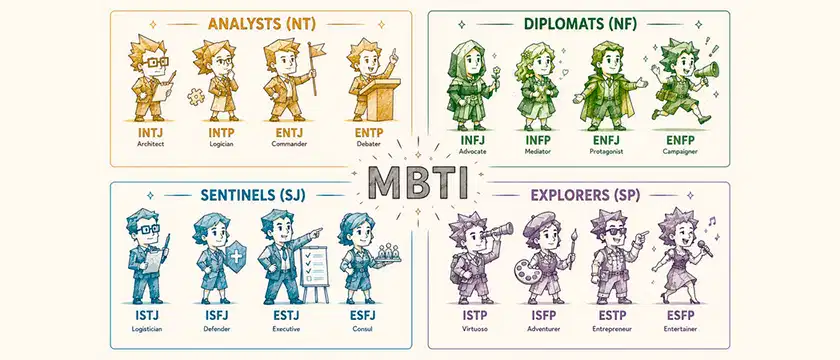
Popular systems describe personality in different ways. For example, the MBTI test offers a typology of 16 types, while the Big Five looks at five continuous scales. These are different approaches, and their results can’t be directly translated into one another.
How to Connect the Big Five to Work
Big Five personality traits don’t assign you a career. The same person can thrive in different conditions, drawing on their skills and choosing ways to organize their day that work for them. Rather than asking, “What career does my result allow me to have?” it’s more useful to ask, “Where might my usual ways of working help me, and where might I need extra support?”
- Openness: If you enjoy novelty, you may be energized by tasks that involve experimentation and idea generation. If you prefer predictability, look for roles with clear processes and opportunities to improve familiar methods.
- Conscientiousness: A love of structure can be useful in project management and keeping track of deadlines. If you prefer flexibility, it can help to agree on key deadlines in advance and use simple reminders.
- Extraversion: Think about how many meetings and interactions feel comfortable for you. In the same profession, you might look for a more public-facing role or tasks that leave more time for independent work.
- Agreeableness: Collaboration matters in almost every job, but some roles involve more tough negotiations or direct feedback. Find out how the team typically handles disagreements.
- Neuroticism: Consider the pace, how predictable the tasks are, and what support is available. Clear priorities and regular feedback can help if uncertainty wears you down.
To test your assumptions, look at job listings and compare not just job titles but the actual responsibilities: how much independence, interaction, routine work, and urgent decision-making each role involves. In an interview, you can ask what a typical week looks like and what happens when priorities change. The DISC test can also help you explore your usual interaction style in work situations; it’s based on a different model and doesn’t measure the Big Five.
Frequently Asked Questions
Can the Big Five give you one personality type?
Usually, the result is a profile of five scores rather than a single type. The combination of scores helps describe individual differences without rigidly sorting people into categories.
Which Big Five trait is the best?
There’s no universally best end of any scale. Whether a trait is helpful depends on the task and context: caution, for instance, can help you spot risks, while a willingness to experiment can help you find a new approach.
Do personality traits change with age?
Yes, they can change, although traits usually retain some degree of stability. Specific behaviors can change more quickly: for example, someone can learn to plan even if they don’t like strict schedules.
Does the career-fit test measure the Big Five?
Not necessarily. The “What Job Suits My Personality?” test offers 16 situational questions about work preferences and environment. Treat the result as a prompt for reflection, not as a profile across the five scales.
Try Putting What You’ve Learned into Practice
The Big Five can help you notice your tendencies without dividing personalities into right and wrong. To keep exploring through practical examples, take the “What Job Suits My Personality?” test and compare the result with your own observations.
If you’d like to look at personality and communication from other angles, try one of these tests: