How Dante’s 9 Circles of Hell are arranged
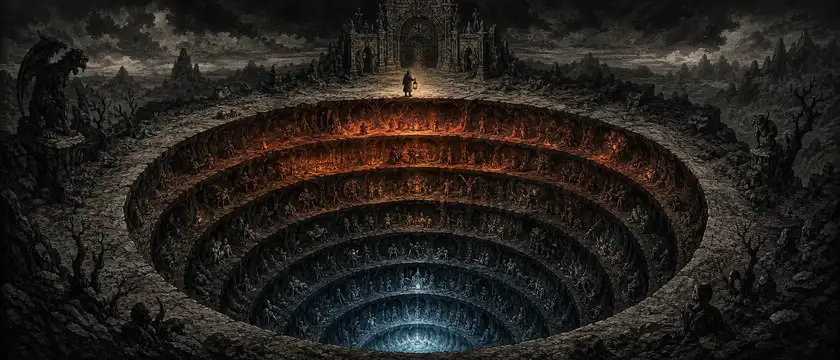
The Divine Comedy is a poem about a journey through Hell, Purgatory and Paradise. In the first part, Dante the character descends underground with his guide, the ancient Roman poet Virgil. At the entrance, they see the souls of the indifferent, who chose neither good nor evil. This place lies outside Hell and is not considered the first circle.
Beyond it begins the funnel proper. The punishments are often tied to the sins according to the principle of contrapasso: they figuratively extend or invert the sin. For instance, those who gave in to passion in life are carried forever by a storm. This is a literary system of symbols, not a guide to judging people.
Here’s a quick guide to the circles of Hell, in order:
- Limbo — virtuous non-Christians and the unbaptized.
- Lust — those who let passion rule their reason.
- Gluttony — those who lived for excessive indulgence.
- Greed and prodigality — those obsessed with wealth or recklessly wasteful of it.
- Wrath — the wrathful and those who harbored dark resentment.
- Heresy — followers of teachings Dante considered heretical.
- Violence — those violent toward others, themselves or what the poet considered the divine order.
- Fraud — swindlers and other deliberate deceivers.
- Treachery — those who betrayed a special bond of trust.
Circles one to three: from Limbo to gluttony
Circle 1: Limbo
Here are those who committed no sins deserving of other punishments but were never baptized or lived before Christianity. They include ancient sages and poets, Virgil among them, as well as unbaptized infants. The souls here are not tortured; their fate is to live without hope of seeing God. Dante depicts it as a quiet but sorrowful place, sometimes described as a noble castle and its surroundings.
Limbo highlights the tension between the poet’s respect for classical culture and the religious beliefs of his time. From a modern perspective, a person’s fate here depends not on harmful actions but on the circumstances of their birth and faith. So this circle shouldn’t be taken as a universal moral judgment.
Circle 2: Lust
The second circle begins with the judgment of Minos: the mythical king hears the sinners’ confessions and points them toward the circle they must descend to. Here, a storm carries the souls of those who let romantic passion rule their reason. Among them are Francesca and Paolo, whose story moves Dante the traveler to deep compassion.
The storm represents a loss of control: just as the wind sweeps the souls along, passion, in the poet’s view, ruled them in life. The modern-day comparison isn’t that love or desire is bad. It’s more about a situation where strong feelings make someone overlook boundaries, commitments and the consequences of their choices.
Circle 3: Gluttony
Here, souls lie in filth beneath a cold, heavy rain, guarded by the three-headed Cerberus. One of the circle’s inhabitants is Ciacco, a Florentine. Instead of the pleasure of eating, Dante shows unending physical discomfort: indulgence brings neither joy nor peace.
In everyday life, the point of this circle isn’t a celebratory dessert but the habit of seeking the same pleasure every time something goes wrong, without thinking about the consequences. At the same time, eating habits and people’s relationships with food shouldn’t be judged by a medieval poem. This fun quiz is no substitute for advice from a professional.
Circles four to six: wealth, wrath and heresy
Circle 4: Greed and prodigality
Two groups of souls push enormous weights toward each other, collide and then turn away. On one side are those who hoarded excessively; on the other, those who spent recklessly. What they have in common isn’t the size of their wallets, but their inability to manage their possessions wisely.
Today, you might recognize this image in two extremes: someone who denies themselves everything to save without a clear goal, or someone who spends to impress others without considering their obligations. Dante isn’t offering a financial plan; he’s reminding us that both saving and spending can become ends in themselves.
Circle 5: Wrath
In the swampy River Styx, the wrathful fight each other. Beneath the surface are the souls of those who harbored dark resentment in life; they cannot speak clearly and only gurgle in the mud. Phlegyas ferries Dante and Virgil across the water, and beyond the swamp rise the walls of the city of Dis.
It’s important here to distinguish between a feeling and an action. Everyone knows what irritation feels like; what matters more is what a person does with it. You might snap at a colleague over a delay, or silently nurse a grudge until an ordinary conversation becomes impossible. Both examples help explain Dante’s metaphor, but they don’t make an everyday conflict an eternal sin.
Circle 6: Heresy
In the city of Dis, heretics lie in open, glowing tombs. Dante meets Farinata degli Uberti and Cavalcante de’ Cavalcanti there. The people punished here held religious beliefs that the poet considered incompatible with the true faith; followers of Epicurus are mentioned in particular, and are said to have believed that the soul is mortal.
This circle makes the historical distance between us and the author especially clear. Today, disagreeing with religious doctrine is not, in itself, a reason to judge someone’s character. To understand the poem, it’s more useful to ask which ideas Dante considered fundamental and why he placed their defenders here.
The seventh circle: violence in three rings
The seventh circle is divided into three rings. The first holds those who committed violence against others and their property: murderers, tyrants and robbers. They are immersed to varying depths in the boiling river of blood, Phlegethon, while centaurs make sure no one rises above their assigned level. The image connects the violence inflicted on others with blood as its consequence.
The second ring is for those who committed violence against themselves. The souls of those who died by suicide are turned into trees in a gloomy wood, while those who squandered their lives and possessions are chased by black dogs. This reflects the harsh beliefs of the time; it is not a modern way to talk about human suffering or judge anyone’s life.
In the third ring, under a rain of fire on burning sand, suffer those Dante considered to have committed violence against God, nature, art or human labor. They include blasphemers, sodomites and usurers. These categories reflect the poet’s worldview and the values of his time; sexual orientation, for example, is not violence. It’s useful to read this scene as evidence of how people once thought, not as a moral rule for today.
Circles eight and nine: fraud and treachery
Circle 8: Fraud
The eighth circle is called Malebolge and consists of ten ditches. It holds various kinds of deceivers: seducers, flatterers, corrupt officials, hypocrites, thieves, false counselors and others. Their punishments vary: fortune-tellers have their heads turned backward, while hypocrites trudge along in heavy cloaks of lead covered with gold on the outside.
The golden cloak is an easy-to-understand metaphor for a polished appearance concealing something false and heavy. In everyday life, not every awkwardly polite gesture is fraud: intent, scale and harm matter. But when someone deliberately creates a false impression to gain another person’s money or trust, the comparison with Dante’s circle becomes clearer.
It’s telling that fraud lies deeper than violence: Dante sees it as an abuse of the ability to reason and deliberately mislead others. You can compare this literary classification with a fun quiz by taking “Which of the Seven Deadly Sins Are You?”—it’s not meant to be a moral diagnosis.
Circle 9: Treachery
At the bottom of the funnel lies the frozen lake of Cocytus. There’s no expected blaze of fire here: the cold underscores the absence of love and loyalty. Traitors are frozen in the ice, with the depth of their immersion depending on which part of the circle they occupy. Lucifer is trapped at the center, chewing on Judas, Brutus and Cassius with his three mouths.
Cocytus is divided into four regions: Caina is for those who betrayed their relatives, Antenora for those who betrayed their country or allies, Ptolomea for those who betrayed their guests, and Judecca for those who betrayed their benefactors. The common thread is the violation of a special bond of trust. If an acquaintance breaks a small promise, that’s not Dantean treachery; but using someone close’s trust to deliberately harm them helps explain why the poet placed this sin so low.
Frequently asked questions
Why are there exactly nine circles of Hell?
The number nine is connected to the number three, which is important to the poem’s structure: the work has three parts—Hell, Purgatory and Paradise. But the structure of the afterlife is Dante’s artistic vision, not a single scheme shared by all religions.
Who is in the most terrifying circle of Hell?
The ninth circle is for traitors. At its center, Lucifer torments Judas, who betrayed Christ, as well as Brutus and Cassius, who took part in the murder of Julius Caesar.
Where do the indifferent end up?
In Hell’s vestibule, before the first circle. Wasps and hornets drive them on as they follow a meaningless banner; strictly speaking, this isn’t one of the nine circles.
Do the circles of Hell correspond to the seven deadly sins?
No. Some sins are familiar, such as gluttony and wrath, but the nine circles follow a different system. For comparison, you can take the quiz “Which of the Seven Virtues Is Yours?”.
Which circle would you end up in?
Dante’s circles of Hell are a map of the author’s moral worldview, not a way to pass judgment on people today. If you’d like to see how this literary framework might apply to everyday situations, take the quiz “Which Circle of Dante’s Hell Would You End Up In?”
And if you’d like to keep playing, here are three more quizzes about sins, virtues and villainous scenarios: