What the brain’s hemispheres do
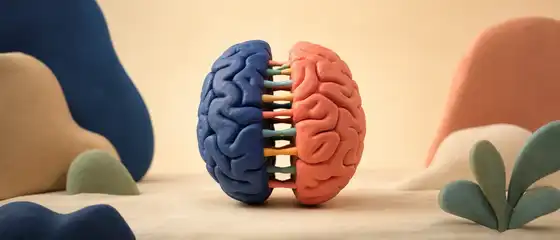
The cerebrum is divided into two hemispheres, connected by bundles of nerve fibers, including the corpus callosum. These connections let information pass from one side to the other. Both hemispheres contribute to perception, movement, memory, and thinking, although their roles can vary from one task to another.
This difference is called functional lateralization. It doesn’t divide people into two categories; it describes how specific processes are organized. For example, in most people, many aspects of language processing are more strongly associated with the left hemisphere. The right hemisphere, meanwhile, helps us pick up on intonation and other features of how speech sounds.
Take the phrase “Well, of course!” To understand it, you need to process the meaning and structure of the words. But the meaning of the response changes depending on whether it’s said with delight, irritation, or irony. In everyday conversation, these cues come together: people rarely communicate what they mean through words alone or tone alone.
The hemispheres also differ in how they control the body: each is primarily linked to movement on the opposite side. Writing with your right hand or keeping time with your left doesn’t mean only one half of your brain is active at that moment. Movement also depends on other processes, including attention, vision, planning, and awareness of your body’s position.
The right hemisphere is often associated with certain aspects of spatial attention. But finding your way around a room, recognizing objects, and planning a route don’t come down to one brain region or one hemisphere. What’s more, the way functions are distributed varies from person to person: general patterns can’t tell us how a particular person’s brain is organized without an examination.
Where the brain hemisphere myth came from
The myth has a real basis: scientists have long studied differences between the hemispheres, including by observing the effects of brain injuries and studying people whose hemispheres have impaired connections. These observations have helped us understand that different brain regions don’t contribute equally to every task.
Pop psychology took the next, unfounded step: it turned the roles of individual functions into supposedly universal personality profiles. In this view, a “left-brained” person supposedly loves numbers and order, while a “right-brained” person prefers images and freewheeling creativity. Those profiles are then used to draw conclusions about someone’s career, character, or even abilities.
The problem isn’t that people are all the same. Our preferences really do differ: some people enjoy making spreadsheets, while others prefer making up stories. But a preference like that can’t tell you which hemisphere dominates your brain overall. What we choose to do is influenced by our skills, experience, interests, circumstances, and goals—not by a simple split between the “analytical” and “artistic” halves of the brain.
You can see this in your own life. You might love a neatly organized to-do list and still enjoy finding an unexpected gift for a friend. You might be into painting and carefully work out the budget for a trip. There’s no need to explain combinations like these by saying you’re “switching” between two types of brain.
Logic and creativity in everyday life
Let’s look at tasks often treated as opposites. Logic isn’t only useful for solving a math problem, and creativity isn’t only useful for painting. In many activities, the two work hand in hand.
- Cooking. You check the proportions and oven time, but you can also come up with a substitute for a missing ingredient. If a dish doesn’t turn out, you figure out why and adjust the recipe.
- Writing. To write a clear email, you need to imagine your reader, choose the right tone, organize your arguments, and check your facts. Imagination and structure aren’t enemies.
- Finding a solution. When your usual route is closed, you come up with alternatives and compare them for time and convenience. It helps to widen your options first, then evaluate them critically.
- Communication. In a disagreement, it’s important to hear the words, pick up on the tone, remember the context, and formulate a response. Success depends on combining these actions, not on your supposed “brain hemisphere type.”
Even a pattern-recognition task doesn’t test pure logic in isolation: you need to hold the instructions in your memory, direct your attention, and recognize visual cues. If you’d like to give it a try, take our logical reasoning test and think about why your chosen answer fits better than the alternatives.
Creative work can involve constraints and checking, too. A designer has to account for screen size, a story writer needs to keep the plot on track, and a musician has to rehearse a difficult passage. A fresh idea and discipline can be part of the same process.
What popular tests actually show
A test about your preferences mainly shows how you respond to the questions it asks. If you’re drawn to plans, words, or images, the result may highlight that preference within the context of that particular questionnaire. But your answers can’t measure activity in your brain’s hemispheres, identify their anatomical features, or prove that one dominates the other.
The name of our main test refers to the familiar idea of the left and right hemispheres. Treat the label you get as a prompt for reflection, not a neuroscience finding. Depending on how the questions are worded and what’s going on in your life, you might see yourself in different descriptions.
To get more out of your result, ask yourself a few specific questions:
- Which answers really describe my habits, and which might depend on my mood or recent experiences?
- When does having a plan help me, and when is it more useful to try a few different options?
- What skill would I like to develop, and what can I do to practice it?
For example, if you find it hard to get started on an open-ended creative task, try sketching out three imperfect ideas. If you struggle to compare options, make a short list of criteria. These are practical exercises—not a way to “switch on” the right hemisphere.
For a different kind of challenge, try our quick IQ test with picture-based puzzles: it asks you to spot patterns against the clock. Its result reflects your performance on that test’s questions and isn’t a substitute for a comprehensive assessment of intelligence. And you can use our archetype test as a prompt to reflect on familiar roles and motivations, without treating the result as a scientific personality classification.
If you have concerns about your health or mental well-being, a test is no substitute for consulting a professional.
Frequently asked questions
Are people left-brained or right-brained?
There are no strict personality types defined by one half of the brain dominating the other. However, some functions really are more strongly associated with one hemisphere.
Is it true that the left hemisphere handles logic and the right handles creativity?
That’s an oversimplification. Logical and creative tasks usually involve networks of different brain regions, and the makeup of those networks depends on the task.
Can you tell which hemisphere is dominant from someone’s dominant hand?
No. Hand preference is related to how movement is organized, but it can’t reliably tell you someone’s overall thinking style, personality, or how all their brain functions are distributed.
Do you need to develop each hemisphere separately?
There’s no need to choose exercises based on whether they’re “for the left” or “for the right.” It’s more useful to set a specific goal—for example, learning to make an argument, developing your drawing skills, or practicing problem-solving.
Stay curious instead of reaching for a label
The hemispheres differ, but people aren’t divided into “logic” and “creativity.” Take our main test to explore your preferences, and remember: the result describes your answers; it doesn’t measure how your brain works.
And if you’d like to keep going, here are a few more tests to explore and practice with: