The ancient world: from agriculture to the fall of Rome
Around 10,000 BCE, people in several regions began to adopt farming and raise animals. This didn’t happen everywhere at once, nor did it mean people immediately stopped hunting. But settlements gradually grew, and food surpluses allowed some people to take up crafts and administration.
In the 4th millennium BCE, large cities and one of the earliest writing systems emerged in Mesopotamia. Written records helped people keep track of goods, debts and taxes. A shopping list on your phone may seem like an everyday thing, but the idea of recording information outside your own memory was a major step in the history of society.
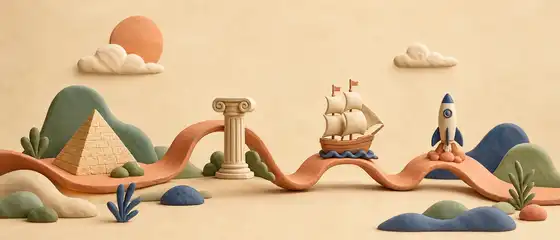
In the 3rd millennium BCE, pyramids were built in ancient Egypt, including the famous Great Pyramid of Giza. States also existed in other regions, such as the Indus Valley and China. Their development shows that world history isn’t a single story running from Egypt to modern Europe. Learn more about the pharaohs and ancient Egyptian beliefs with our Ancient Egypt quiz.
In the 5th century BCE, democracy developed in Athens, where citizens took part in discussing and making decisions. But not all residents had citizenship rights: women, enslaved people and foreigners were excluded from political life. Athens is an important example in the history of democracy, but its system was not the same as modern universal suffrage.
In 476 CE, the last emperor of the Western Roman Empire was deposed. This date is often used as an approximate dividing line between antiquity and the Middle Ages in European history. The Eastern Roman Empire, known as Byzantium, continued to exist for almost another thousand years.
The Middle Ages: religion, trade and the exchange of knowledge
In the 7th century, Islam emerged on the Arabian Peninsula. In the centuries that followed, the Muslim world encompassed vast territories where trade, medicine, mathematics and other fields of knowledge flourished. Scholars translated and studied works from different traditions, while trade routes linked cities from the Mediterranean to Asia.
The Middle Ages weren’t a time of complete stagnation. Cities grew, universities appeared, and merchants carried goods and ideas from place to place. The Silk Road wasn’t a single road but a network of routes along which silk, paper, technologies and religious ideas travelled. Gunpowder and the compass, for example, gradually spread to the wider world from China and other countries.
In the 13th century, Mongol conquests created a vast empire across Eurasia. They brought destruction and loss of life, but also changed the conditions for trade and long-distance travel. It’s important to remember both sides of this process: closer connections didn’t erase the violence that accompanied them.
In the 14th century, the plague epidemic known as the Black Death claimed many lives in Asia, Europe and North Africa. It affected work, the economy and everyday life. And in 1453, the Ottomans captured Constantinople, bringing the Byzantine Empire to an end. This date is also used as one of the approximate dividing lines between the Middle Ages and the modern era.
The mid-15th century is also associated with the rise of printing in Europe: Johannes Gutenberg used a printing press with movable type. Printing technologies had emerged earlier in East Asia, however. Compare inventions like these in our “Which Came First?” quiz.
The modern era: ocean routes, revolutions and factories
In 1492, Christopher Columbus’s expedition reached the Caribbean islands. For the people of the Americas, this wasn’t the “discovery” of their lands: many peoples and states had long existed there. The voyage was part of the beginning of sustained contact between the Americas and Europe, followed by conquest, epidemics, colonial rule and the forced displacement of people.
Trade across the Atlantic changed what people ate around the world. Potatoes and tomatoes, which originated in the Americas, gradually became everyday foods in Europe and beyond. But this exchange also included the transatlantic slave trade: millions of Africans were forcibly transported across the ocean and enslaved.
In 1517, Martin Luther’s protest was one of the events that sparked the Reformation, a movement that transformed Europe’s religious and political life. In the centuries that followed, the Scientific Revolution and the Enlightenment strengthened interest in observation, evidence, human rights and how power should be organized. These ideas spread gradually and sparked debate.
In 1776, the Declaration of Independence was adopted in the United States, and in 1789, the French Revolution began. Its calls for liberty and equality influenced political movements in many countries, though the revolutionary years themselves were marked by violence and power struggles. In 1804, Haiti declared independence: its revolution grew out of an uprising by enslaved people and became a major event in the history of the struggle against slavery.
From the late 18th century, the Industrial Revolution transformed production as machines and factories gradually became central to the economy. Steam engines helped drive the growth of railways and transport. These changes had a real impact on families: people moved to cities and worked in factories, often in harsh conditions. Later, labour movements campaigned for limits on working hours and other workers’ rights.
The 20th and 21st centuries: wars and an interconnected world
World War I, from 1914 to 1918, involved many countries and led to the collapse of several empires. Its effects went beyond redrawn borders: enormous losses, economic hardship and political conflicts continued to shape lives after the fighting ended.
World War II, from 1939 to 1945, was even more devastating. Nazi Germany and its allies waged a war of conquest; the Holocaust led to the murder of six million Jews, while people from other groups were also persecuted and killed. In 1945, the United States dropped atomic bombs on the Japanese cities of Hiroshima and Nagasaki. The United Nations was founded that same year.
After the war came the Cold War, a long-running conflict between the USSR and the United States and their allies. It involved an arms race, competition in space and conflicts in different regions, though the two superpowers never fought a major war directly. In 1969, humans first set foot on the Moon: the crew of the American Apollo 11 showed just how far space technology had advanced.
Decolonization was taking place at the same time: many countries in Asia and Africa gained independence from European powers. The process took different forms and didn’t automatically resolve every economic and political problem. In 1989, the Berlin Wall fell, and in 1991, the USSR dissolved. These events were major milestones in the end of the Cold War.
By the end of the 20th century, the internet had become widely accessible, and the World Wide Web made it easy to move between pages using links. The internet and the web aren’t the same thing: the internet connects networks, while the web runs on top of it. So sending an email, shopping online and reading this article are all part of the broader history of communications and computing.
In 2020, the World Health Organization characterized the spread of COVID-19 as a pandemic. Border closures, remote work and the shift of many services online showed just how closely countries are connected—and how quickly a global event can change an ordinary day.
Frequently asked questions
Where should I start when studying world history?
Start with the sequence of eras: the ancient world, the Middle Ages, the modern era and the contemporary era. Then pick out a few key events and look at what was happening in different regions at the same time. The boundaries between eras are approximate and usually reflect European periodization.
Which dates in world history should I learn first?
Start with 476, 1453, 1492, 1789, 1914, 1939 and 1991. Don’t just memorize the numbers; understand what they’re connected to. For example, 1789 marks the start of the French Revolution, not its end.
Why can the same event be viewed in different ways?
Its effects depend on whose experience we’re looking at. Ocean voyages expanded trade opportunities for European powers, but for many Indigenous peoples of the Americas they meant conquest, disease and loss of land. It’s useful to compare different perspectives and sources.
How can I remember historical timelines without rote learning?
Link dates through cause and effect, and look for familiar examples. The spread of printing, for instance, is connected to greater access to books, while the Industrial Revolution is linked to factories and railways. Brush up on what you know across a range of subjects with our general knowledge quiz.
See what you remember
World history makes more sense when dates become chains of events, decisions and changes in everyday life. Take our “World History Quiz” and see how well you know the different eras.
And if you’d like to keep going, try our other history and general knowledge quizzes: