The History of Ancient Egypt: Thousands of Years Along the Nile
The history of a united ancient Egypt is usually said to begin around the turn of the fourth and third millennia BCE, when Upper and Lower Egypt came under the rule of a single king. Upper Egypt was the southern stretch along the upper reaches of the Nile, while Lower Egypt was the northern region of the delta. The names may seem surprising on a modern map, but they refer to the river’s flow, not to where the regions appear on a page.
Egypt’s history is divided into periods, including the Old, Middle and New Kingdoms. They were separated by times of division and change. So it’s worth remembering that many centuries passed between the age of the pyramid builders and the reign of Tutankhamun. Capitals, ideas about power, art and relations with neighboring peoples all changed over time.
The Nile was the foundation of Egypt’s economy. Its annual floods deposited fertile silt on the fields. Once the waters receded, farmers worked the soil and sowed grain. Canals helped carry water to farmland, while the harvest fed cities and supported officials, priests and craftspeople.
Egypt had close ties with neighboring lands: it traded, sent out military expeditions and also went through periods of foreign rule. In 30 BCE, after the death of Cleopatra VII, Egypt became part of the Roman Empire. To compare its history with other eras, try our world history quiz.
Pyramids: Tombs Built Over Generations
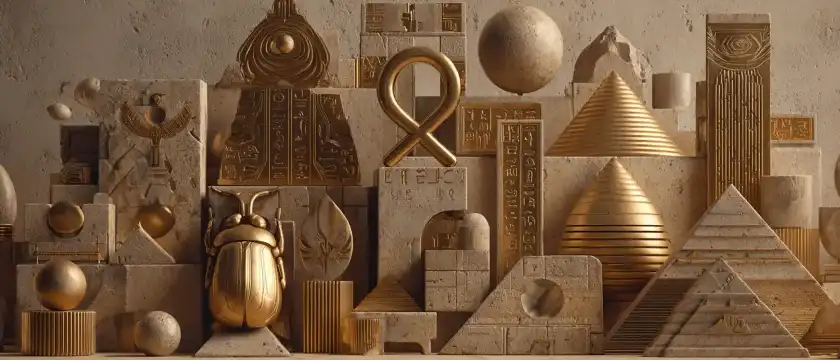
The pharaohs’ pyramids formed part of funerary complexes. Nearby, there might be temples, processional roads and other tombs. The best-known group stands at Giza: the pyramids of Khufu, Khafre and Menkaure, also known as Cheops, Chephren and Mykerinos.
The Pyramid of Khufu is the largest of the three and the only one of the Seven Wonders of the Ancient World still standing. It was originally covered in smooth limestone casing stones, so it looked different from the way it does today. Most of the casing has disappeared over time.
The pyramid shape did not appear all at once. One early example is the Step Pyramid of Djoser at Saqqara. Unlike the familiar shape with smooth sides, it is made up of several levels that become smaller toward the top. These structures show how ancient architects’ ideas evolved.
The common idea that pyramids were built exclusively by enslaved people is an oversimplification. Archaeological finds near Giza, including workers’ settlements and burials, point to the involvement of organized work crews. They included skilled craftspeople and laborers who were provided with what they needed to live.
Egyptians needed stonemasons, haulers, cooks and people to keep records. Simple tools, including sledges, were used to move blocks; researchers are still studying the details of how individual pyramids were built. The Great Sphinx beside the pyramids is not a tomb but a monumental sculpture with a lion’s body and a human head.
Pharaohs: Rulers, Warriors and Builders
The pharaoh stood at the head of the state and held a special place in Egyptian religious beliefs. His authority was tied to maintaining order, justice and the well-being of the country. Temples were built in the ruler’s name, military campaigns were organized and resources were gathered, though many officials handled the day-to-day work.
Among the best-known pharaohs is Tutankhamun. He died young and was not the most powerful ruler of his era. His tomb in the Valley of the Kings, discovered in 1922, brought him worldwide fame: it contained many funerary objects, including the famous golden mask.
Not all rulers were men. Hatshepsut ruled as pharaoh during the New Kingdom. Building projects took place during her reign, and an expedition was sent to the land of Punt, as shown in the reliefs at her mortuary temple. In some images, Hatshepsut appears with traditional symbols of royal power, including a false beard.
Another famous ruler was Cleopatra VII of the Ptolemaic dynasty. She lived much later than the builders of the great pyramids: more than two thousand years separated the construction of Khufu’s pyramid from her reign. Her story helps put the length of Egyptian history into perspective. Test your sense of chronology with our “Which Came First?” quiz.
Everyday Life in Ancient Egypt
Most people farmed and depended on the harvest. Wheat, barley and flax were grown in the fields. Grain was used to make bread and beer, everyday staples of the Egyptian diet. Vegetables, fruit and fish rounded out the menu, though what families could afford naturally varied.
Imagine the work of a scribe: recording how much grain had been brought in for storage, drawing up a document or passing on an order. Writing helped manage the economy, and training as a scribe offered a path to a government job. People wrote on papyrus as well as on other materials, such as pottery shards and stone surfaces.
Homes were often made of sun-dried mud brick. These buildings survive less well than stone temples, which is why monumental structures stand out more in the modern landscape. But archaeologists also find traces of ordinary life: pottery, tools, toys, jewelry and the remains of homes.
Egyptians wore linen clothing, jewelry and cosmetics. Dark eyeliner was used by both men and women. It was not just for appearance: people also associated it with protection and symbolism.
Cats were valued in part for their ability to catch rodents, and they also took on religious significance. But it would be wrong to imagine that every cat was a god in its own right: animals could be associated with gods and take part in religious practices in different ways.
Gods, Mummies and the Decipherment of Hieroglyphs
Egyptian religion included many gods, whose images and significance varied by place and period. The sun was associated with the god Ra, the afterlife with Osiris, and the goddess Isis was worshipped, among other things, as a protector. Anubis was often depicted with the head of a jackal and was associated with funerary rites.
Egyptians believed in life after death, so burial was important. The body of a deceased person might be mummified, and objects thought useful in the next world could be placed in the tomb. Rulers and the elite left behind especially lavish burial complexes; the rites available to people varied depending on the period and a family’s means.
Mummification helped preserve the body, but not every ancient Egyptian burial looked like a royal tomb. Archaeologists also find animal mummies, which were part of some religious practices.
Writing helped unlock the story of these beliefs. Hieroglyphs appear on the walls of temples and tombs. These signs could represent sounds as well as meanings. For a long time after the ancient tradition disappeared, no one knew how to read them.
The key to deciphering them was the Rosetta Stone: the same decree appears on it in hieroglyphs, Demotic script and ancient Greek. In the 19th century, Jean-François Champollion made a decisive contribution to understanding hieroglyphs. If you’re interested in ancient figures, try our “Which Mythological God or Goddess Are You?” quiz too.
Frequently Asked Questions
When did ancient Egypt exist?
The history of the unified state is usually traced back to around the end of the fourth millennium BCE. In 30 BCE, Egypt became part of the Roman Empire, though Egyptian culture continued to exist and evolve.
Who built the pyramids at Giza?
Ancient Egyptians built them on the orders of the pharaohs Khufu, Khafre and Menkaure. Organized groups of workers and skilled craftspeople took part in the construction.
Why were the dead mummified?
Mummification was connected to the belief in an afterlife and the desire to preserve the body. Burial practices varied depending on the period and a family’s means.
Why did Egyptians build settlements along the Nile?
The river provided water and a transport route, while its floods helped keep the fields fertile. This was especially important in an arid climate.
See What You Remember
The history of ancient Egypt brings monumental structures together with everyday concerns, from keeping track of grain to preparing for the Nile’s floods. See what you remember about the gods, pharaohs and pyramids in our main Ancient Egypt quiz.
And if you’d like to keep going, here are a few more quizzes on history and mythology: